10  Data & Merge

This chapter covers the two primary datasets — CERF storm allocations and OCHA cyclone population exposure estimates — along with the storm ID matching process that links them and the merge that produces the analysis dataset.

Code
import sys
sys.path.insert(0, "..")

import ocha_stratus as stratus
import pandas as pd
import numpy as np
import matplotlib.pyplot as plt
import matplotlib.ticker as mticker
from great_tables import GT, loc, style
from plotnine import *
import warnings
from dotenv import load_dotenv

warnings.filterwarnings("ignore", module="plotnine")

load_dotenv()

df_ocha = stratus.load_parquet_from_blob(
    "ds-storm-impact-harmonisation/processed/adm0_ibtracs_exp_all.parquet"
)

10.1 OCHA Cyclone Exposure Dataset

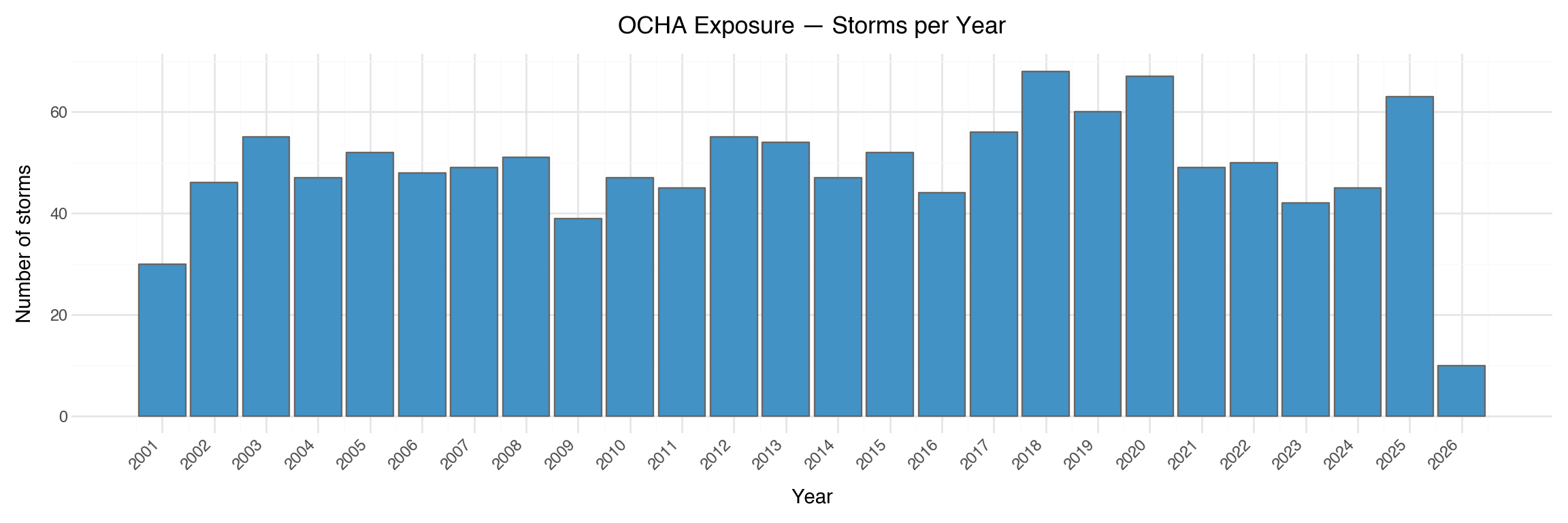
The ADAM and GDACS exposure datasets proved unusable for this analysis due to temporal gaps (see Section 11.3). However, the OCHA exposure dataset (adm0_ibtracs_exp_all.parquet) covers 2001–2026 with 1,271 storms and uses IBTrACS sid directly — giving us near-complete overlap with CERF.

Code
print(f"Shape: {df_ocha.shape}")
print(f"Columns: {list(df_ocha.columns)}")
print(f"Unique storms (sid): {df_ocha['sid'].nunique()}")
print(f"Unique countries (ADM0_A3): {df_ocha['ADM0_A3'].nunique()}")
print(f"Wind speed thresholds: {sorted(df_ocha['speed'].unique())} kt")

df_ocha["year"] = df_ocha["sid"].str[:4].astype(int)
print(f"Year range: {df_ocha['year'].min()}{df_ocha['year'].max()}")
Shape: (4467, 4)
Columns: ['speed', 'sid', 'pop_exposed', 'ADM0_A3']
Unique storms (sid): 1271
Unique countries (ADM0_A3): 114
Wind speed thresholds: [np.int64(34), np.int64(50), np.int64(64)] kt
Year range: 2001–2026

Three cumulative wind speed thresholds (34, 50, 64 kt) with population exposure per country. The data is confirmed cumulative: pop at 34 kt >= 50 kt >= 64 kt.

Code
from src.datasets.cerf import pivot_ocha_wide

wide = pivot_ocha_wide(df_ocha)

both_34_50 = wide.dropna(subset=["pop_exp_34kt", "pop_exp_50kt"])
both_50_64 = wide.dropna(subset=["pop_exp_50kt", "pop_exp_64kt"])
print(f"34kt >= 50kt: {(both_34_50['pop_exp_34kt'] >= both_34_50['pop_exp_50kt']).all()}")
print(f"50kt >= 64kt: {(both_50_64['pop_exp_50kt'] >= both_50_64['pop_exp_64kt']).sum()}/{len(both_50_64)} rows")
34kt >= 50kt: True
50kt >= 64kt: 620/621 rows
Code
storms_per_year = (
    df_ocha.drop_duplicates("sid")
    .groupby("year")
    .size()
    .reset_index(name="n_storms")
)

(
    ggplot(storms_per_year, aes("year", "n_storms"))
    + geom_col(fill="#4292c6", color="#666666")
    + scale_x_continuous(breaks=range(storms_per_year["year"].min(), storms_per_year["year"].max() + 1))
    + labs(x="Year", y="Number of storms", title="OCHA Exposure — Storms per Year")
    + theme_minimal()
    + theme(
        figure_size=(12, 4),
        axis_text_x=element_text(rotation=45, ha="right"),
    )
)

Number of storms per year in the OCHA exposure dataset.

10.2 CERF Storm Allocations (API Pipeline)

CERF storm allocation data is sourced from the CERF GMS API, filtered to Storm emergency type and Rapid Response window. Each allocation is linked to an IBTrACS storm via a curated ApplicationCode -> sid dictionary (CERFCODE_TO_SID in src/datasets/cerf.py).

Code
from src.datasets.cerf import (
    load_cerf_api_data,
    apply_cerfcode_sids,
    build_analysis_dataset_api,
    CERFCODE_TO_SID,
)

df_cerf_api = load_cerf_api_data()
print(f"CERF API storm allocations: {len(df_cerf_api)}")
print(f"Year range: {int(df_cerf_api['Year'].min())}{int(df_cerf_api['Year'].max())}")
print(f"Countries: {df_cerf_api['CountryCode'].nunique()}")

n_matched = sum(1 for v in CERFCODE_TO_SID.values() if v is not None)
n_non_tc = sum(1 for v in CERFCODE_TO_SID.values() if v is None)
print(f"\nCERFCODE_TO_SID: {len(CERFCODE_TO_SID)} entries")
print(f"  Matched to TC: {n_matched}")
print(f"  Non-TC (excluded): {n_non_tc}")
CERF API storm allocations: 95
Year range: 2007–2026
Countries: 34

CERFCODE_TO_SID: 96 entries
  Matched to TC: 85
  Non-TC (excluded): 11
Code
# Build a global storm name lookup from IBTrACS
engine = stratus.get_engine("prod")
all_sids = sorted({s for s in CERFCODE_TO_SID.values() if s is not None})
with engine.connect() as conn:
    sid_names = pd.read_sql(
        f"SELECT sid, name FROM storms.ibtracs_storms "
        f"WHERE sid IN ({','.join(repr(s) for s in all_sids)})",
        conn,
    )
sid_name_map = dict(zip(sid_names["sid"], sid_names["name"]))

10.2.1 Non-TC Allocations

These allocations are classified as “Storm” in the CERF system but are not tropical cyclones (inland flooding, tornadoes, etc.). They are excluded from the analysis.

Code
df_matched = apply_cerfcode_sids(df_cerf_api)
non_tc_codes = {k for k, v in CERFCODE_TO_SID.items() if v is None}
non_tc = df_cerf_api[df_cerf_api["ApplicationCode"].isin(non_tc_codes)]
display(
    non_tc[["ApplicationCode", "CountryName", "Year", "TotalAmountApproved"]]
    .sort_values("Year")
    .reset_index(drop=True)
    .rename(columns={
        "CountryName": "Country",
        "TotalAmountApproved": "Amount (USD)",
    })
)
ApplicationCode Country Year Amount (USD)
0 07-RR-SDN-13738 Republic of the Sudan 2007 1159499.0
1 07-RR-UGA-11920 Uganda 2007 6001015.0
2 07-RR-RWA-10462 Rwanda 2007 416325.0
3 07-RR-SDN-10078 Republic of the Sudan 2007 2663285.0
4 07-RR-MLI-7117 Mali 2007 1017103.0
5 07-RR-GHA-5535 Ghana 2007 2496956.0
6 10-RR-BOL-453 Bolivia 2010 2486524.0
7 10-RR-COL-2904 Colombia 2010 3640647.0
8 11-RR-ZWE-12668 Zimbabwe 2011 977054.0
9 19-RR-CUB-34583 Cuba 2019 1995221.0
10 20-RR-PAK-41273 Pakistan 2020 3000016.0

10.3 CERF–Exposure Merge

Code
merged_agg = build_analysis_dataset_api(df_ocha)
merged_agg["storm_name"] = merged_agg["sid"].map(sid_name_map)

10.3.1 Merged Dataset

Code
print(f"Storm-country pairs: {len(merged_agg)}")
print(f"Unique storms: {merged_agg['sid'].nunique()}")
print(f"Countries: {merged_agg['iso3'].nunique()}")
print(f"Year range: {int(merged_agg['allocation_year'].min())}{int(merged_agg['allocation_year'].max())}")
print(f"Total CERF: ${merged_agg['total_usd'].sum():,.0f}")
Storm-country pairs: 68
Unique storms: 57
Countries: 25
Year range: 2007–2026
Total CERF: $365,264,993
Code
merged_agg.sort_values("total_usd", ascending=False)[
    ["Country", "iso3", "sid", "storm_name", "allocation_year", "total_usd",
     "pop_exp_34kt", "pop_exp_50kt", "pop_exp_64kt"]
]
Country iso3 sid storm_name allocation_year total_usd pop_exp_34kt pop_exp_50kt pop_exp_64kt
10 Myanmar MMR 2008117N11090 NARGIS 2008 26417370.0 19333692.0 4048393.0 2208832.0
18 Philippines PHL 2013306N07162 HAIYAN 2013 25284204.0 28890700.0 16565265.0 10168586.0
7 Bangladesh BGD 2007314N10093 SIDR 2007 19692303.0 138170560.0 89294760.0 27572576.0
33 Mozambique MOZ 2019063S18038 IDAI 2019 14018121.0 4900148.0 3142120.0 2315791.0
47 Philippines PHL 2021346N05145 RAI 2021 11974601.0 30291796.0 19172290.0 12772280.0
... ... ... ... ... ... ... ... ... ...
37 Bahamas BHS 2019236N10314 DORIAN 2019 1002151.0 129230.0 52998.0 33809.0
0 Philippines PHL 2006329N06150 DURIAN 2007 938214.0 50348248.0 22613136.0 11771776.0
8 Dominican Republic DOM 2007345N18298 OLGA 2007 774539.0 10489032.0 1622045.0 NaN
9 Mozambique MOZ 2008062S10064 JOKWE 2008 548913.0 5627767.0 2382697.0 990164.0
46 Fiji FJI 2020346S13168 YASA 2021 500000.0 862865.0 116364.0 111359.0

68 rows × 9 columns

Code
fig, (ax1, ax2) = plt.subplots(1, 2, figsize=(12, 4))

yearly = merged_agg.groupby("allocation_year").agg(
    n_allocations=("total_usd", "size"),
    total_usd=("total_usd", "sum"),
)

ax1.bar(yearly.index, yearly["n_allocations"], color="#4292c6", edgecolor="#666")
ax1.set_xlabel("Year")
ax1.set_ylabel("Number of storm-country pairs")
ax1.set_title("Allocation count")

ax2.bar(yearly.index, yearly["total_usd"] / 1e6, color="#ef6548", edgecolor="#666")
ax2.set_xlabel("Year")
ax2.set_ylabel("Amount (millions USD)")
ax2.set_title("Total amount allocated")

plt.tight_layout()
plt.show()

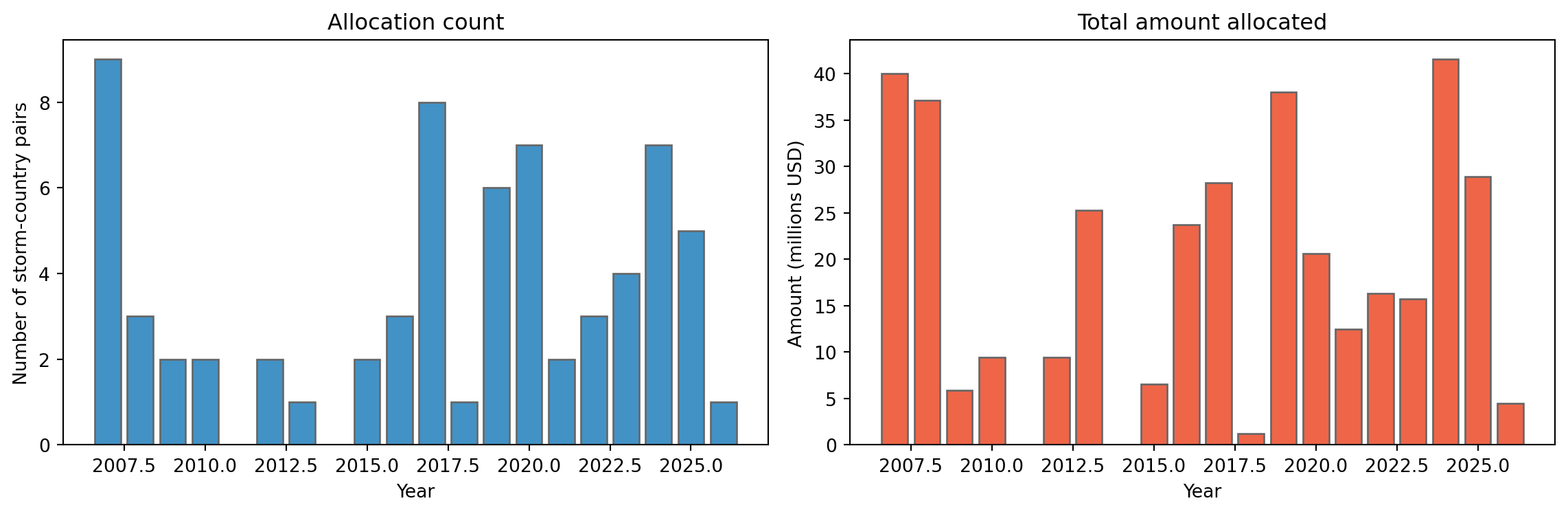
CERF storm allocations by year (API pipeline, after merge with exposure data).

10.4 Exposure Coverage Gaps

Not all storms with CERF allocations have corresponding entries in the OCHA exposure dataset. This section documents the coverage gap.

Code
cerf_valid_api = df_matched.dropna(subset=["sid"])
ocha_wide_api = pivot_ocha_wide(df_ocha)
merged_api = cerf_valid_api.merge(ocha_wide_api, on=["sid", "iso3"], how="left")
exp_cols = ["pop_exp_34kt", "pop_exp_50kt", "pop_exp_64kt"]
merged_api["has_exposure"] = ~merged_api[exp_cols].isna().all(axis=1)

10.4.1 Summary

Code
n_tc = len(cerf_valid_api)
n_with_exp = merged_api["has_exposure"].sum()
n_without_exp = (~merged_api["has_exposure"]).sum()
n_sids_missing = merged_api.loc[~merged_api["has_exposure"], "sid"].nunique()

print(f"CERF allocations matched to TC sids: {n_tc}")
print(f"  → with exposure data:              {n_with_exp}")
print(f"  → without exposure data:           {n_without_exp} ({n_sids_missing} unique storms)")
CERF allocations matched to TC sids: 84
  → with exposure data:              77
  → without exposure data:           7 (6 unique storms)

10.4.2 Missing storm–country pairs

The table below lists CERF allocations that have a valid IBTrACS sid but no matching record in the OCHA exposure data. There are two causes:

  1. Storm absent entirely — the storm was never processed by the OCHA exposure pipeline (no records for any country).
  2. Country not covered — the storm exists in the exposure data but not for the specific country that received CERF funding.
Code
gap = merged_api[~merged_api["has_exposure"]].copy()

# Check which sids have *any* record in OCHA exposure
all_ocha_sids = set(df_ocha["sid"].unique())
gap["sid_in_ocha"] = gap["sid"].isin(all_ocha_sids)
gap["gap_reason"] = gap["sid_in_ocha"].map(
    {False: "Storm absent from exposure data", True: "Country not in exposure for this storm"}
)

gap["storm_name"] = gap["sid"].map(sid_name_map)

display(
    gap[["Country", "iso3", "sid", "storm_name", "allocation_year", "Amount in US$", "gap_reason"]]
    .sort_values(["gap_reason", "allocation_year"])
    .reset_index(drop=True)
)
Country iso3 sid storm_name allocation_year Amount in US$ gap_reason
0 El Salvador SLV 2009308N11279 IDA 2009 2485827.0 Country not in exposure for this storm
1 Malawi MWI 2019063S18038 IDAI 2019 3352045.0 Country not in exposure for this storm
2 Guatemala GTM 2020306N15288 ETA 2020 2522190.0 Country not in exposure for this storm
3 Guatemala GTM 2011280N10268 NaN 2011 2201628.0 Storm absent from exposure data
4 Malawi MWI 2023036S12117 FREDDY 2023 5500000.0 Storm absent from exposure data
5 Mozambique MOZ 2023036S12117 FREDDY 2023 9995213.0 Storm absent from exposure data
6 Madagascar MDG 2024084S12054 GAMANE 2024 3000000.0 Storm absent from exposure data
Code
gap_summary = (
    gap.groupby("gap_reason")
    .agg(
        n_rows=("sid", "size"),
        n_storms=("sid", "nunique"),
        total_usd=("Amount in US$", "sum"),
    )
    .reset_index()
)

(
    GT(gap_summary)
    .tab_header(
        title="CERF Allocations Without Exposure Data",
    )
    .cols_label(
        gap_reason="Reason",
        n_rows="Rows",
        n_storms="Unique storms",
        total_usd="Amount (USD)",
    )
    .fmt_currency("total_usd", currency="USD", decimals=0)
)
CERF Allocations Without Exposure Data
Reason Rows Unique storms Amount (USD)
Country not in exposure for this storm 3 3 $8,360,062
Storm absent from exposure data 4 3 $20,696,841

These gaps represent a data limitation — the OCHA exposure pipeline has not processed every storm. Notably absent are storms like FREDDY (2023), one of the longest-lived tropical cyclones on record, and GAMANE (2024). These allocations are excluded from the regression analysis but remain in the full CERF inventory for reference.

10.5 Comparison with Old CSV Pipeline

The original analysis used a CSV export with manually assigned storm IDs and algorithmic auto-matching. The API pipeline replaces this with a curated dictionary. This section compares the resulting analysis datasets.
Code
from src.datasets.cerf import build_analysis_dataset, DEFAULT_MANUAL_OVERRIDES

df_cerf_old = stratus.load_csv_from_blob(
    "ds-storm-impact-harmonisation/processed/cerf-storms-with-sids-2024-02-27.csv"
)
merged_old = build_analysis_dataset(
    df_cerf_old, df_ocha, manual_overrides=DEFAULT_MANUAL_OVERRIDES
)
merged_old["storm_name"] = merged_old["sid"].map(sid_name_map)
Code
summary_df = pd.DataFrame([
    {
        "Pipeline": "Old CSV",
        "Storm-country pairs": len(merged_old),
        "Unique storms": merged_old["sid"].nunique(),
        "Countries": merged_old["iso3"].nunique(),
        "Year range": f"{int(merged_old['allocation_year'].min())}{int(merged_old['allocation_year'].max())}",
        "Total CERF (USD)": merged_old["total_usd"].sum(),
    },
    {
        "Pipeline": "CERF API",
        "Storm-country pairs": len(merged_agg),
        "Unique storms": merged_agg["sid"].nunique(),
        "Countries": merged_agg["iso3"].nunique(),
        "Year range": f"{int(merged_agg['allocation_year'].min())}{int(merged_agg['allocation_year'].max())}",
        "Total CERF (USD)": merged_agg["total_usd"].sum(),
    },
])

(
    GT(summary_df)
    .tab_header(title="Pipeline Comparison Summary")
    .fmt_currency("Total CERF (USD)", currency="USD", decimals=0)
    .fmt_number(["Storm-country pairs", "Unique storms", "Countries"], decimals=0)
)
Pipeline Comparison Summary
Pipeline Storm-country pairs Unique storms Countries Year range Total CERF (USD)
Old CSV 59 51 23 2006–2023 $298,267,410
CERF API 68 57 25 2007–2026 $365,264,993

10.5.1 New pairs in API pipeline

Code
old_keys = set(zip(merged_old["sid"], merged_old["iso3"]))
new_pairs = merged_agg[
    ~merged_agg.apply(lambda r: (r["sid"], r["iso3"]) in old_keys, axis=1)
].copy()

(
    GT(
        new_pairs[["Country", "iso3", "sid", "storm_name", "allocation_year", "total_usd"]]
        .sort_values("allocation_year")
        .reset_index(drop=True)
        .rename(columns={"total_usd": "Amount (USD)", "allocation_year": "Year", "storm_name": "Storm"})
    )
    .tab_header(
        title=f"{len(new_pairs)} New Storm-Country Pairs",
        subtitle="In API pipeline but not in old CSV pipeline",
    )
    .fmt_currency("Amount (USD)", currency="USD", decimals=0)
)
13 New Storm-Country Pairs
In API pipeline but not in old CSV pipeline
Country iso3 sid Storm Year Amount (USD)
Bangladesh BGD 2024145N14087 REMAL 2024 $7,415,323
Grenada GRD 2024181N09320 BERYL 2024 $1,500,000
Jamaica JAM 2024181N09320 BERYL 2024 $2,498,400
Philippines PHL 2024293N13141 TRAMI 2024 $10,581,075
Cuba CUB 2024293N21294 OSCAR 2024 $3,499,569
Cuba CUB 2024309N13283 RAFAEL 2024 $5,999,888
Mozambique MOZ 2024345S11062 CHIDO 2024 $10,053,709
Cuba CUB 2025291N11319 MELISSA 2025 $7,500,016
Haiti HTI 2025291N11319 MELISSA 2025 $4,000,001
Jamaica JAM 2025291N11319 MELISSA 2025 $3,999,999
Philippines PHL 2025308N10143 FUNG-WONG 2025 $5,948,201
Madagascar MDG 2026030S16043 FYTIA 2025 $7,499,998
Mozambique MOZ 2025068S15046 JUDE 2026 $4,500,001

10.5.2 Pairs dropped from old pipeline

Code
api_keys = set(zip(merged_agg["sid"], merged_agg["iso3"]))
dropped = merged_old[
    ~merged_old.apply(lambda r: (r["sid"], r["iso3"]) in api_keys, axis=1)
].copy()

if len(dropped) > 0:
    (
        GT(
            dropped[["Country", "iso3", "sid", "storm_name", "allocation_year", "total_usd"]]
            .sort_values("allocation_year")
            .reset_index(drop=True)
            .rename(columns={"total_usd": "Amount (USD)", "allocation_year": "Year", "storm_name": "Storm"})
        )
        .tab_header(
            title=f"{len(dropped)} Dropped Storm-Country Pairs",
            subtitle="In old CSV pipeline but not in API pipeline",
        )
        .fmt_currency("Amount (USD)", currency="USD", decimals=0)
    )
else:
    print("No pairs were dropped — the API pipeline is a strict superset.")